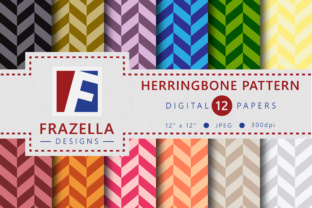
The Herringbone Digital Paper Collection
The Herringbone Digital Paper Collection is a curated set of 12 high-resolution JPEG files featuring the classic herringbone pattern—a timeless, interlocking zigzag design rooted in textile and architectural traditions. Each file is optimized for digital use and print reproduction, with consistent color fidelity and scalable clarity at standard resolutions (typically 300 DPI). The collection includes one cohesive set, meaning all papers share a unified aesthetic—consistent line weight, spacing, and tonal balance—without variation in motif or scale across the 12 files.
Who Might Consider This Collection?
Designers, educators, crafters, and small-business owners often seek repeatable, licensable background patterns for projects where visual cohesion matters but custom pattern creation isn’t feasible. The Herringbone Digital Paper Collection may appeal to those needing:
- Print-ready textures for greeting cards, invitations, or stationery;
- Layered backgrounds in digital scrapbooking, Canva templates, or Procreate composites;
- Subtle, structured backdrops for social media graphics or presentation slides;
- Consistent branding elements across multiple deliverables without licensing ambiguity.
It’s especially relevant for users who prioritize simplicity over customization—those who want a reliable, no-edit-required starting point rather than a toolkit requiring pattern manipulation or color adjustment.
Key Benefits and Practical Advantages
The primary benefit lies in immediacy and compatibility. As JPEGs, the files open in virtually any image editor, layout application, or web-based design tool without plugin dependencies or format conversion. Their high resolution supports crisp printing up to letter-size (8.5" × 11") and common card dimensions (e.g., 5" × 7", A6) without visible pixelation. Because the herringbone motif is inherently geometric and symmetrical, the patterns tile seamlessly—making them suitable for repeated use across larger surfaces like banners or fabric mockups.
Another practical advantage is consistency: with only one set and no variant scales or colorways included, users avoid decision fatigue when selecting among dozens of options. This can streamline workflows for time-constrained creators or those maintaining strict brand guidelines.
Tradeoffs and Limitations to Acknowledge
There are notable constraints to consider before choosing The Herringbone Digital Paper Collection. First, it contains only 12 files—all JPEGs—with no alternate formats (e.g., PNG with transparency, vector EPS or SVG, or PSD layers). That limits flexibility for projects requiring alpha channels, non-destructive editing, or scalable resizing beyond standard print sizes.
Second, the collection offers no built-in color variants. If your project demands warm-toned neutrals, pastel versions, or high-contrast monochrome, you’ll need to adjust hues manually—or source additional assets. Similarly, there’s no inclusion of coordinating elements (e.g., borders, frames, or icons), so building a full design system requires supplementary resources.
Third, licensing terms aren’t specified in the product description. Users should verify permitted usage—especially for commercial applications such as selling physical products (e.g., printed planners) or distributing digital templates—before committing.
When This Collection Is a Strong Fit
The Herringbone Digital Paper Collection works well in scenarios where speed, reliability, and visual restraint are priorities. For example:
- A teacher preparing printable classroom handouts with a clean, professional texture;
- A freelance designer assembling a client’s holiday card suite on a tight deadline;
- A hobbyist creating digital scrapbook pages who values tactile-feeling structure without complex layering;
- A small business owner developing branded PDF worksheets or lead magnets that require subtle, non-distracting backgrounds.
In each case, the herringbone pattern provides visual interest without competing with foreground content—its rhythm is noticeable but not dominant, making it functionally versatile across text-heavy and image-light layouts.
When Alternatives May Be Worth Exploring
If your work involves frequent re-coloring, scaling to billboard size, or integration into layered design systems, broader or more flexible options may serve better. Consider alternatives if you need:
- Vector-based herringbone patterns: For infinite scalability and precise path editing in Illustrator or Affinity Designer;
- Multi-format bundles: Collections that include both JPEG and PNG variants, plus editable source files;
- Themed expansions: Sets that pair herringbone with complementary motifs (e.g., chevron, linen, or marble) for coordinated design libraries;
- Licensed-for-resale collections: Assets explicitly cleared for use in digital products sold on marketplaces like Creative Market or Etsy.
Similarly, if your workflow relies heavily on generative tools (e.g., Adobe Firefly or Canva’s AI background generator), manually sourced JPEGs may introduce unnecessary steps compared to on-demand pattern generation—though output control and stylistic predictability remain advantages of pre-made assets like The Herringbone Digital Paper Collection.
Making an Informed Decision
To determine whether The Herringbone Digital Paper Collection aligns with your needs, ask yourself three questions:
- What’s my primary use case? If it’s print-ready, single-layer backgrounds for short-run physical items or static digital graphics, this collection meets core functional requirements.
- How much customization do I anticipate? If you routinely adjust saturation, invert colors, or overlay textures, confirm your editing software supports non-destructive JPEG adjustments—or budget time for manual tweaks.
- What are my distribution plans? Review the license agreement carefully. Even if the files are marketed for “personal and commercial use,” some licenses exclude use in physical goods intended for resale unless upgraded.
Finally, compare file count and format against similar offerings. Some collections provide 24–36 papers across multiple patterns; others offer fewer files but include vectors or mockup templates. The value of The Herringbone Digital Paper Collection lies not in volume, but in its focused execution of a single, widely applicable motif.
For users seeking a dependable, no-frills herringbone resource—without the overhead of learning new tools or managing complex asset libraries—this collection delivers predictable results. It won’t replace a full design system, but it can reliably anchor specific, well-defined creative tasks.